Ice Melt Buying & Application Guide
Choosing a product, reading the label, spreading it evenly and protecting concrete, plants and pets.
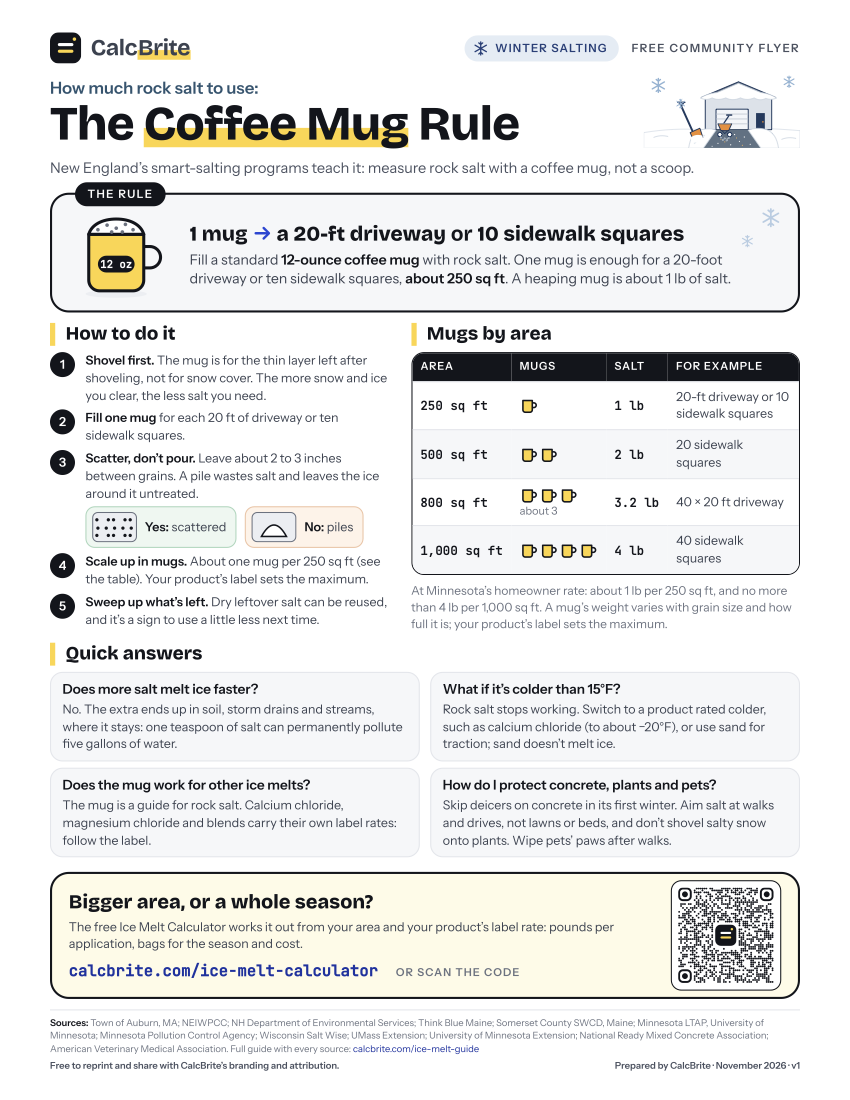
Not sure which product or application rate to use? Read the Ice Melt Guide →
Look for Directions, Application rate or Coverage on the back of the bag, and enter both numbers with their units. If the label gives cups, use its weight equivalent, or weigh one cup. If it shows a range, use the amount you plan to apply, never more than the label allows.
3.2 lb
of ice melt for one application
800 sq ft × 4 lb per 1,000 sq ft
1 × 20-lb bag covers this application
Coverage rates are product-specific, so follow the rate on your label rather than a general rule, and never use more than it allows. Where a label gives a range, start at the low end: package rates are often more than most conditions need.23 Treat only the surfaces people actually walk or drive on.5
Yes. Clearing snow first is a key general best practice, and ice melt isn’t a substitute for removing deep snow. Spread it on the thin layer of ice or snow that’s left.5
Read the label for suitable surfaces, the application rate, temperature limits and precautions for concrete, plants, pets and nearby water. Products in the same category can carry different cautions.
Multiply your driveway’s area by the rate on the bag, then divide by the bag weight and round up. At an example label rate of 4 lb per 1,000 sq ft, a 40 × 20 ft driveway (800 sq ft) needs 3.2 lb per application, so one 20-lb bag covers it several times.
It depends on the product. Rock salt labels state their own rate, usually per 1,000 sq ft or per square yard; enter it above and the calculator converts it for your area.34
It depends on the rate on the label: coverage (sq ft) = bag weight (lb) ÷ rate (lb per 1,000 sq ft) × 1,000. At a rock salt label’s 10 oz per sq yd (about 69 lb per 1,000 sq ft), 50 lb covers about 720 sq ft; at a calcium chloride label’s 28 lb per 1,000 sq ft, about 1,790 sq ft, or 3,570 at its 14-lb low end. Divide the coverage by your area for applications per bag: at 28 lb, 2 for a 40 × 20 ft driveway.34
Check the label. Some products warn against use on new concrete or certain surfaces, and cautions vary by brand, so CalcBrite doesn’t make a blanket claim either way. Concrete industry guidance is to avoid deicers on new concrete in its first winter, and labels commonly limit use to concrete at least a year old.634
Rock salt is one kind of ice melt (sodium chloride). Other ice melts use calcium chloride, magnesium chloride or blends, with different labels, rates and temperature ranges.
4 lb per 1,000 sq ft is an example label entry used to show the math, not a recommended rate.